Deferred Interest Vol. 32
love, money, and the AI bubble

A Valentine? In this economy?
Even though it feels like the year just started, Valentine’s Day is already here. Not to take all the romance out of it, but the holiday is a big economic event. This year, the National Retail Federation predicts consumer spending will reach a record $29.1bn. Holiday consumers are expected to spend ~$200 on average for gifts (no gentlemen, this isn’t a requirement).
Much of the data is unsurprising. The top gift categories are candy, flowers, and greeting cards. An evening out and jewelry are not far behind.
If you are participating in Valentine’s Day this year, whether that’s with significant others, friends, co-workers, etc. I’d encourage you to shop from your favorite small businesses and start-ups. While $29.1bn is a large number, it’s typically Amazon, big box stores, and 1-800-Flowers capturing the financial benefits.
A few recommendations below:
Chocolates: Alice Mushrooms
Wine/Spirits: Brown Estate, Fallen Grape, and Body Vodka
Fragrance & Candles: Harlem Candle Co
Jewelry: Stephanie Gottlieb
Beauty Prep: Live Tinted, Danessa Myricks, and Soft Services
That $200 means a lot more to small businesses trying to bring their vision to more consumers than it does to a trillion-dollar company’s bottom line. Support the entrepreneurs building the economy from the ground up!
Now, let’s get into some news.
If you enjoy Deferred Interest, please drop a like 🤍 (and if you’re feeling frisky, a comment) below. Your engagement brings this content to more readers. I appreciate you!
AI Companies Get Petty (And I'm Here For It)
If you watched the Super Bowl Benito Bowl, you might’ve caught Anthropic’s tongue-in-cheek ad series taking shots at OpenAI. Their tagline, “Ads are coming to AI. But not to Claude.”
For context, OpenAI announced they’d start testing ads in their free and lower-tier ChatGPT plans in early 2026. Pro, Business, and Enterprise subscriptions remain ad-free. They market this as a practical move because subscriptions and enterprise deals alone don’t cover the astronomical costs of running AI at scale. Ads help keep access broad and affordable while diversifying revenue beyond paid users.
It’s not dissimilar from what we’ve seen as other tech platforms matured.
But Anthropic saw an opportunity and ran with it.
Meanwhile OpenAI’s Super Bowl ad took a more earnest and inspirational approach approach, showing how people can use ChatGPT to accomplish their dreams. Very classic “we’re changing the world” energy.
And then Sam Altman took his thoughts to X
Sam Altman responded to Anthropic’s commercials on X, and he certainly had thoughts. The full response is worth reading below, but I’ll tell you what started out diplomatic enough quickly progressed to a pointed shot.

I can understand why OpenAI is running ads (P.S. see below on the AI bubble). Running AI at this scale is wildly expensive, and keeping a robust free tier accessible requires finding revenue somewhere else.
But watching these AI leaders take jabs at each other via X and Super Bowl commercials is the kind of start-up drama I live for. I’m just here watching it all unfold.
So About that AI Bubble…
Last week, I attended an All Raise Lunch & Learn event at Silicon Valley Bank where they walked through their State of the Markets report for the first half of 2026. While the report covered various dynamics across tech and the VC landscape, I zeroed in on what major institutions are saying about the so-called AI bubble, and what it could mean for all of us.
Here’s what’s happening
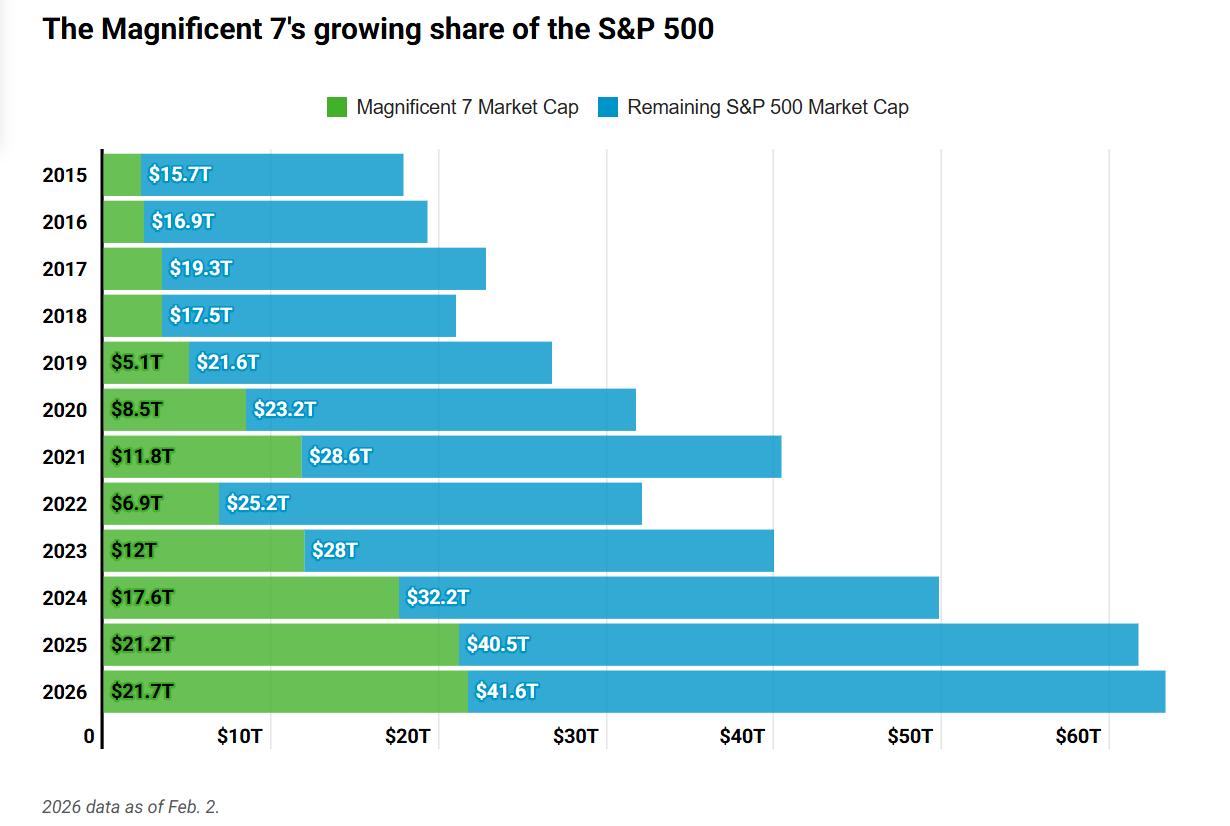
Since October 2022, ~75% of the gains in the S&P 500 have come from just seven stocks (out of 500!). This bundle of companies, known as the “Magnificent Seven” includes Alphabet, Amazon, Apple, Meta, Microsoft, Nvidia, and Tesla. Their strategies, perhaps excluding Apple, are heavily dependent on AI, and right now, a massive concentration of the world’s investable assets sits in AI and AI-adjacent stocks.
These companies are pouring unprecedented amounts of money into AI infrastructure like new data centers, large language models, and the massive amounts of electricity required to power them. Throughout earnings season, large tech companies have guided toward their expected spending for 2026. Amazon, Alphabet, Microsoft, Meta, and Oracle are expected to comprise $600bn. The outlay from those five companies is more than the combined market caps of two giant companies like McDonald’s ($232bn) and Netflix ($352bn).
On the private markets side, five AI companies captured one-third of US tech VC funding in 2025. Capital is piling into a handful of “mega-rounds” instead of spreading across more deals.
We’re all thinking it…
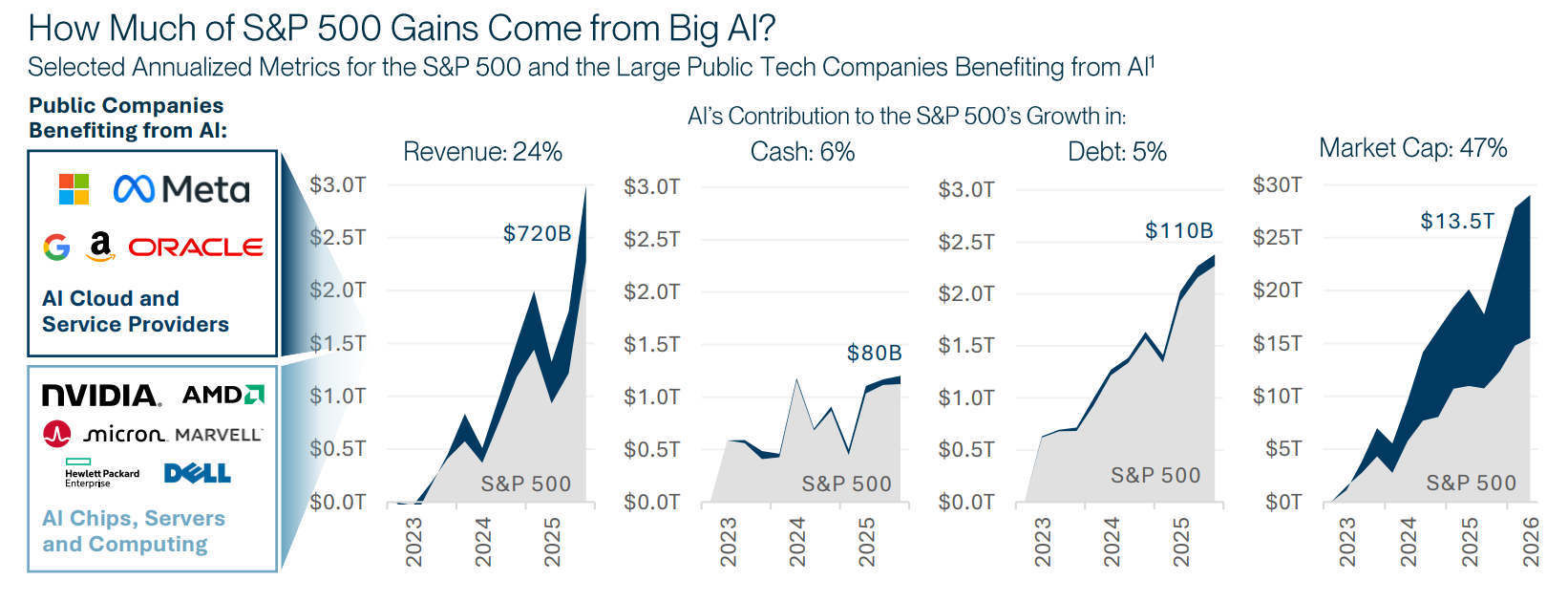
Can these companies actually generate enough revenue and financial gain to justify this level of investment?
The graphic below illustrates that large public tech companies benefitting from AI have driven 47% of market cap growth, but only 24% of revenue growth.
If the answer turns out to be no, if AI falls short of expectations, it could send the stock market tumbling, affecting everything tied to it, including your 401(k) and other invested capital.
We’ve (kinda) been here before
This scenario has similarities to the late 1990s dot-com bubble. Back then, investors poured money into internet-based companies, and telecom firms built out massive infrastructure—tens of millions of miles of fiber-optic cables—to support the anticipated boom.
The profits never materialized. Investors sold off their shares, companies collapsed, and the Nasdaq lost more than three-fourths of its value. It took 15 years to recover.
What’s different this time
This all comes down to the "scaling hypothesis," the belief that as AI systems get larger and more sophisticated, they'll unlock enough transformative value to justify the spending. Hence the $100 billion deals from Nvidia and AMD, Amazon’s $100 billion data center buildout, and Meta’s $600 billion commitment over three years.
Many believe AI represents the future and we’re in more of a “boom” than a “bust”. As one investor told SVB, “I’ve seen several big tech waves over my career—internet, mobile, SaaS, cloud—AI is the biggest. It’s also the most competitive.”
But there’s always a catch
The SVB report highlights some concerning signs of what they call, “overexuberance in AI”:
High burn multiples
Low revenue per employee
High valuation premiums for companies with less revenue than their peers
Five AI companies have achieved values three times higher than all dot-com era IPOs combined
As SVB puts it, “We are certain AI will generate long-lasting gains, but we are equally certain the path to value creation and innovation is marked with expensive and perhaps necessary mistakes.”
The bottom line (for now)
Whether we’re in a bubble or a genuine technological revolution remains to be seen. What’s certain is that massive capital is concentrated in AI right now, and the outcomes will have significant implications for the broader economy and your own wallet.
The challenge, as the SVB report describes it, is “catching the AI wave, without getting sucked under by the backwash of overhype.”
There's no question that AI is transformative, but whether current valuations and investment levels match the actual returns these companies can generate remains to be seen.
That’s all for this week! Thanks for reading.
X
Jamie
This was an EXCELLENT take on the AI bubble/boom and articulated so many of the thoughts swirling in my head. This puts more sophisticated words to the underlying “picks and shovels” strategy I think (read: hope) will end up being the saving grace of AI.